MODULE 8.2: Shooting positions and stances for Shotguns

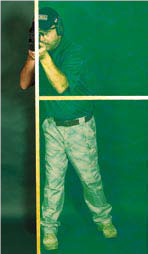
- The shotgun/rifle shooting position or stance resembles that of a boxer in the ring–feet spread apart, well balanced, arms and trunk free to swing to the right and the left of the target.
- This position must be comfortable and natural to allow quick movement in any direction.
- When shooting, the body weight shifts to the leading leg (left leg if you shoot right-handed, right leg if you shoot left-handed).
- The leading hand holds the shotgun fore-end and points naturally to the target area. You don’t aim the shotgun/rifle, you point it at your target.
- The front foot must point towards the target. The front leg is slightly
- The mass is on the front leg.

- The mass of the body must be spread in such a way that the front leg supports the minimum mass. All moving parts of the body must be kept upright by applying the least muscular tension.
- The head must be upright to ensure a good view.
- The weak elbow must be supported by the weak knee.
- The legs are spread with the heels on the ground and the hips and shoulders in line. The position must make provision for:
- Remaining in the same position for a long period of time.
- Good stability of the weapon by applying the least muscular tension.
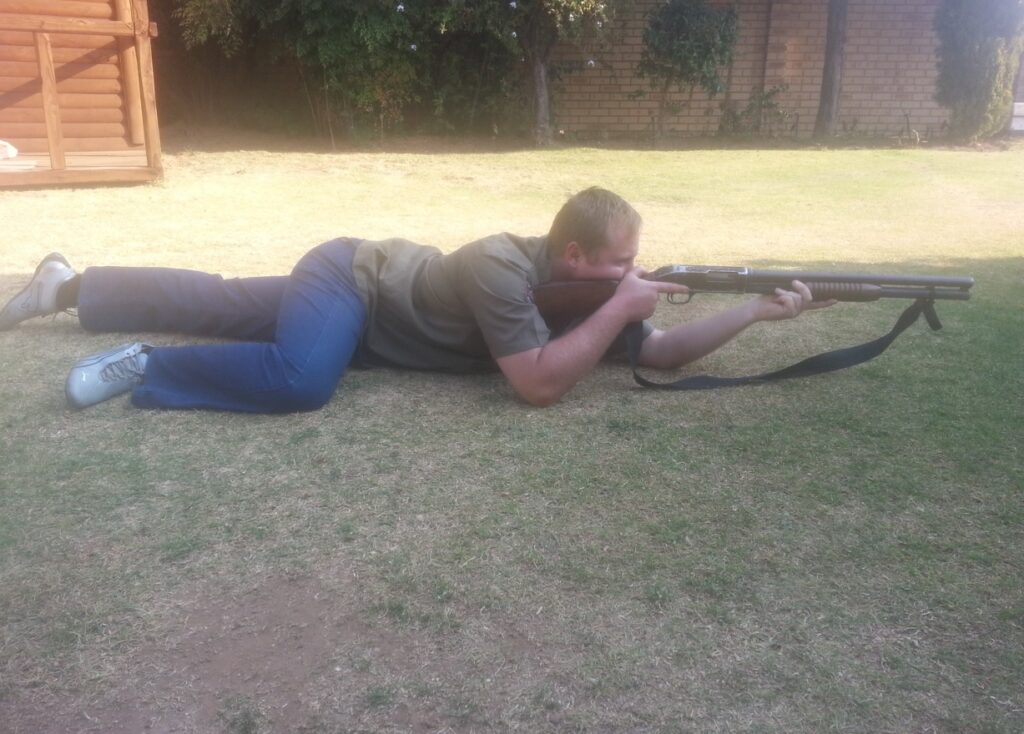
- The prone position is the steadiest shooting position and the one from which the fundamentals of rifle or shotgun shooting are best learned. It is a good position for firing accurate long-distances shots.
- If you are right-handed, lie on your stomach with your body slightly to the left of the line of aim. If you are left-handed, reverse this position.
- Keep your back straight and legs in a relaxed position.
- Both elbows should be bent, and your shoulders curved slightly forward to form a solid upper body position. The upper-body and arms support the rifles and shotguns weight.
When people hear the term “Low Light shooting” What they most often think of is shooting in the dark. And most people don’t have the ability to train in low light or reduced light or dark conditions. So, this is a skill that is not practiced in my opinion as much as it should be. However, this is a skill that can be practiced along with your daily “Dry Fire Training” or with a “Blue Gun” and a Flashlight you can practice clearing your own home. “The fear of the dark works both ways; you will be better prepared if you train in low and reduced light.” Although this seems to be an acceptable practice by law enforcement agencies it is not an advisable technique to use, for the following reasons: –
- It pins points your position.
- It gives the marksmen a clear point to aim at.
- And it does not give you total control over your firearm.
Taking Cover
(Behind Barricades): COVER (BARRICADES) & CONCEALMENT.
This module deals with the concept of shooting a shotgun competently. You have obviously become aware of the fact that much emphasis has been placed on safety. This chapter deals with the use of cover and concealment is an additional and essential requirement built into the Unit Standard and was placed there for a specific reason. During the assessment, you must demonstrate your ability to shoot competently whilst making use of cover. In a realistic or tactical environment, you must be able to choose your own cover with discretion and haste. Suitable cover may not always be available at the time, so your second option would be concealment or camouflage – in other words, making yourself invisible.
Choosing appropriate cover
In the real world, the cover you choose must be reliable enough to withstand the fire-power of the aggressor’s firearm and ammunition. The cover you choose must also provide total body concealment. In an urban environment walls, buildings and vehicles usually offer the best cover. The following aspects will provide you with a few essential guidelines:
- Determine as quickly as possible an imaginary line of fire between you and your
- A vehicles door does not provide reliable cover; – rather use the engine as cover.
- If you are right-handed, you will always shoot around the right side of the cover.
- If you are left-handed, you will always shoot around the left side of the cover.
- The cover must allow free use of your firearm.
In my opinion, avoidance is always the best option, but in circumstances where you are unable to flee or avoid a confrontation try, you’re very best to be the most difficult target to hit as possible. The following can be used as guidelines:
- Try to imagine what your attacker is seeing and thinking.
- Stay away from lighted areas in dark or low-light conditions.
- Create confusion for your attacker by changing your position and the objects you use for cover.
- Consider the use of a decoy to confuse your attacker and, to determine your attacker’s
- If your decoy gets hit by a bullet – stay concealed behind your cover until it is safe to Use whatever cover and concealment is available at that specific point in time, for example:
- Low sand banks or folds in the
- Trenches
- Trees
- Curbs on the side of roads.
- Fire hydrants.
- Pillars
- Darkness, and misty conditions.
Always ensure that you make yourself as Small a target as possible